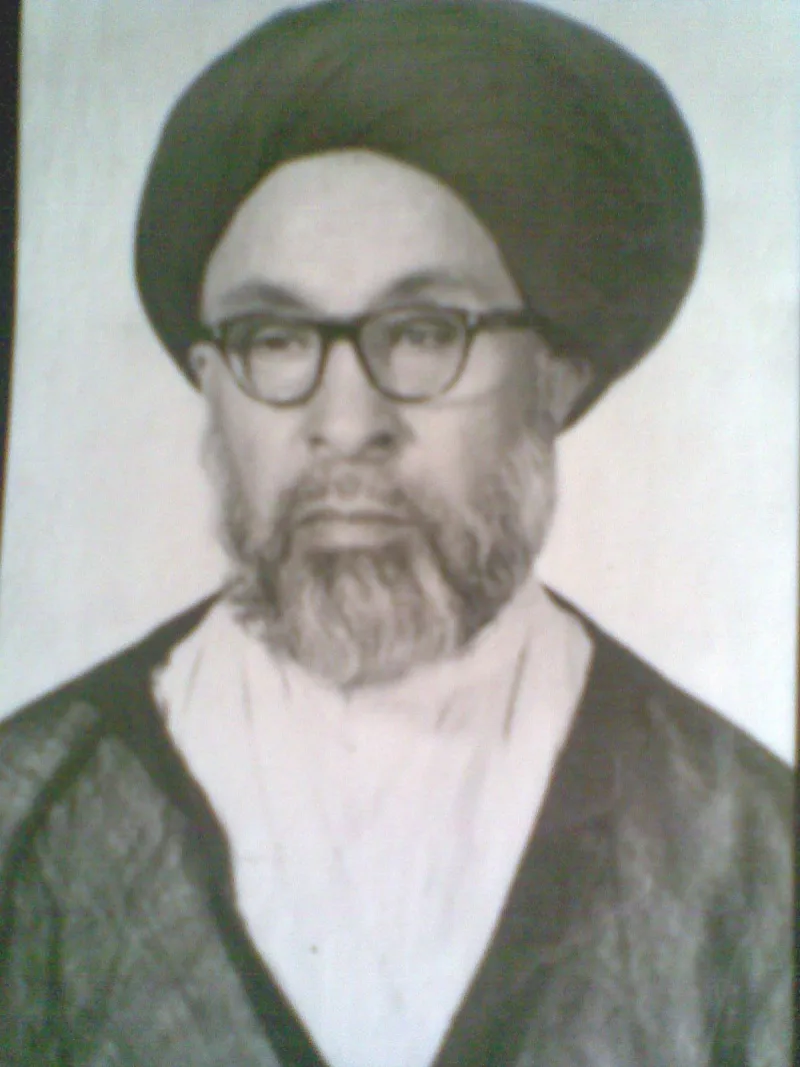
Biography
Early Life
Born in the Zadibal locality of Srinagar, Kashmir, into a family of religious preachers. His father, Agha Syed Hussain Rizvi (d. 1942), and his uncle, Agha Syed Hassan (d. 1928), were prominent local clerics who helped develop the religious gatherings of the region. His genealogy is traced to Imam Ali al-Ridha. He received his earliest education at home from his father.
Ayatollah Agha Syed Ahmed Rizvi Kashmiri, widely known as Aga Sahib, was a Shia Islamic jurist, teacher and religious reformer who lived and worked in Srinagar, the capital of Kashmir. Born in the Zadibal neighbourhood of Srinagar, he belonged to a family long associated with the religious life of the region; his father, Agha Syed Hussain Rizvi, and his uncle, Agha Syed Hassan, were preachers who helped organise and develop the community's religious gatherings. His lineage is traditionally traced back to Imam Ali al-Ridha, the eighth Imam of the Shia.
He received his first lessons at home from his father before travelling for further study. He spent three years in Lucknow, then a leading centre of Shia learning in the Indian subcontinent, and afterwards journeyed to Najaf in Iraq, one of the foremost seats of Shia scholarship. There he studied for more than two decades under some of the era's most celebrated authorities, including Mirza Muhammad Hussain Na'ini and Sayyid Abul Hassan Isfahani, and his studies and travels also took him through Iran, Syria and Palestine.
After years of advanced study he attained the rank of Ijtihad, qualifying him as a mujtahid able to derive religious rulings independently. He then returned to Kashmir, where he became one of the most influential Shia religious figures of his time, guiding the community on matters of law, worship and practice.
His most enduring contribution was in the field of religious education. He founded the Madarsa Mohammadia seminary in Srinagar, giving Kashmir's Shia community a formal institution for the study of Islamic sciences, and he delivered regular lectures on jurisprudential subjects. Through this work he is credited with strengthening structured Shia scholarship in the valley.
Contemporaries held him in high esteem. He was remembered by some as a Mard-e-Mujahid, a striving and steadfast man of faith, and others spoke of him as a person of deep spiritual standing. Alongside his juristic learning he was associated with the gnostic, or Irfani, dimension of Islam.
He died on 9 July 1964, corresponding to the 28th of Safar 1384 in the Islamic calendar, at his residence in Srinagar, following a religious gathering. He is remembered in Kashmir as a leading scholar and seminary founder who helped shape the modern religious life of the region's Shia community.
Education & Training
Early religious education at home under his father
Three years of study in Lucknow, India
Over two decades at the Hawza 'Ilmiyya of Najaf, Iraq, under scholars including Mirza Muhammad Hussain Na'ini and Abul Hassan Isfahani
Further study/travel in Iran, Iraq, Syria and Palestine
Attained the qualification of Ijtihad (mujtahid)
Positions & Achievements
Shia religious leader (Ayatollah/mujtahid) of Kashmir, c. 1931-1964
Founder of the Madarsa Mohammadia seminary in Srinagar
Delivered regular lectures on Islamic jurisprudence
Books & Works
Best remembered for founding the Madarsa Mohammadia seminary in Srinagar and for establishing and strengthening formal Shia religious education and jurisprudential teaching in Kashmir during the mid-20th century.